
A Map To Manhood
Why men are lost and what to do about it.

The Men Are Not Alright
It’s hard to be a man in modern Western society.
Men, by and large, do not know what to do with themselves. They are consistently outperformed by women at school and are falling as a percentage of attendees of higher education. They take on the most physically grueling and dangerous jobs and are much more likely to find themselves injured or dead from accidents. Men kill themselves four times as often as women. Millions of men, unable to function by society’s rules, find themselves locked in prison. Millions more find themselves in cycles of addiction and depression, stuck with their habits of consuming alcohol, weed, food, video games, and the dopamine-hit slop of today’s internet.
But even the “successful” men are barely hanging on. In the essay “The Men Are Not Alright based on her experience dating men in the Bay Area, the as-yet anonymous author finds that almost every man she meets is lost. Most of these men are fairly successful by the usual metrics — being able to pay rent in the Bay Area is a Herculean task unto itself! Yet they seem just as lost as the most dysfunctional parts of society:
Many of my dates turn into pseudo-therapy sessions, with men sharing emotional traumas they’ve kept bottled up for years. One moment I’m learning about his cat named Daisy, and then half a latte later, I’m hearing a detailed account of his third suicide attempt, complete with a critique of the food in the psychiatric ward
…
Most men are not accustomed to genuine questions about their well-being, and will often respond with a desperate upwelling of emotion.
The men are not alright.
The problem is that men don’t have a map. They don’t know what it takes to be a man, and there is no generally accepted path that a man can take that will result in society turning and saying to him “Yes, you’ve done it! Congrats!” Most societies for most of human history have had a very clear roadmap for men. This generally involved marrying, having children, being a financial provider, and serving as the head of a household. Coupled with rigidly enforced class and religious norms, a man could have extremely concrete life goals. Today, we live in a liberal society, where free association and exchange mean that one is faced with a plenitude of choices for how one conducts his life. Furthermore, we live in a feminist society, in which there is no domain that is strictly held aside for men. Men are no longer the sole providers, philosophers, leaders, or household decision-makers.
It’s almost impossible to write about men’s issues without either (a) antagonism toward feminism, or (b) constant throat-clearing reminding the reader “But I’m a good feminist, I swear!” (I’m looking at you, Richard V Reeves!) So I’m going to get my throat-clearing out of the way now. Please remember the following paragraph every time you think “but is this guy really just a misogynist who wants to revive patriarchy?” I am not going to spend my time repeatedly assuring people that no, really, I don’t hate women.
Feminism — by which I mean the complete political, legal, and social equality of the sexes — is great. For most of human history, men have dominated women. The past hundred years or so has seen a tremendous revolution in which women have gained rights previously unimaginable. In much of the world patriarchy is still the rule, and even in societies that have gained legal sexual equality, sexist social habits persist. We ought to rejoice in what we have done and constantly aim to improve the rights of all people.
Yet the men are not alright. A society liberating itself from sex oppression must grapple with the destruction of previous routes to meaning and manhood. What is a man supposed to be? The aforementioned anonymous author does her best to synthesize the messaging men get from polite society. It’s a vague self-contradictory hodgepodge. Men are to reject “toxic masculinity” without ever getting a clear definition of this concept. They’re to be their “authentic self” only to find that their personal traits are considered unwanted or problematic. They’re to provide for and protect others without ever acknowledging such archaic stereotypes. Men must not obsess about “being a man,” despite the fact that our society can’t stop talking about sex and gender. And no matter how well he fulfills these nebulous exhortations, a man should expect nothing in return.
A Map to Manhood
Another quote from the essay The Men Are Not Alright:
… the wild success of “manosphere” influencers is proof that young men are desperate for authority figures to tell them exactly how to become a man. Yet right now the only people filling this niche seem to be creeps such as the Tate brothers, who are preaching a version of manhood that revolves around intimidation, trickery, and abuse.
We need to give good, moral men the license to openly discuss their personal path to manhood in a positive light, and not be accused of being sexists who are “reinforcing the patriarchy.” Millions of young men are desperate for these discussions; our options are either to give them the most positive versions possible, or leave them to feed on the dangerous slop produced by the likes of the Tates.
Importantly, when these discussions occur, there needs to be a focus on positivity. It can’t simply be a list of things you shouldn’t be. Don’t be lazy, don’t be violent, and don’t harass women are all vital lessons. But only hearing a list of “do nots” is a great way to make boys attach a feeling of shame to their gender and resentment toward those who preach those lessons.
Positivity needs to be woven into the core of the message; we need more “dos” than “do nots.” And those “dos” need to be specific and understandable.
Well, I’m doing it.
I’m a good, moral man. I have succeeded in finding happiness in my life, a place in my community, the love of my family, meaning in my work, and a sense of manhood. And I’m here to tell you how to be a man.
This Map of Manhood is still more general than many maps men have been given over the centuries. Concrete tasks such as “get married,” “join [X] profession,” or “perform [Y] religious ritual” are here replaced by the general principles toward which those tasks point. This is a map for men in liberal Western society. It doesn’t aim to box men into a particular living situation, career path, or relationship model. But it is still clear, concrete, achievable. There are four steps. Do these, and you will be a man.
Step 1: Build Character
This is listed as the first step, but it is also the last. It is the step that never ends and must always be prioritized.
Building character means training your virtues, i.e. building habits of mind and action that will make you excellent. “Excellent” could be taken to mean morally excellent — abiding by principles of conduct that serve the well-being of others and society. Alternatively, it could be taken to mean personally excellent — behaving in such a way that brings personal success and happiness. The fundamental insight of virtue ethics is this: moral excellence and personal excellence are one and the same. By mastering the virtues, you will find that you do right by others and enjoy the fruits of a life well lived.
No need to leave you hanging; here are the virtues you must develop:
Integrity
Living in alignment with your deepest values and principles, being honest, forthright, and consistent in your word.Rationality
Using reason, clear thinking, and healthy epistemic habits to always orient toward truth.
Temperance
Exercising self-control and moderation, mastering your impulses rather than being mastered by them.Compassion
Acting to protect and help those who are vulnerable, suffering, or in need of support.Courage
Facing fear, difficulty, and opposition with resolve while doing what is right.Justice
Dealing fairly and honestly with others, giving each person what they are due.Generosity
Freely giving your time, resources, and energy to benefit others.Perseverance
Maintaining unwavering determination to follow through on your commitments and principles despite obstacles or setbacks.Humility
Maintaining an accurate view of yourself, your abilities, and your place in the world without false pride or self-deception.Equanimity
Maintaining inner calm and balanced judgment, especially during times of stress or conflict.
A large part of this project will be focused on developing these virtues. This list is not canonical to any particular tradition, but is instead drawn from various great traditions in order to provide what is demanded of the modern Western man. Christianity, the Enlightenment, and Buddhism have the largest influences on this list.
Step 2: Carry Weight
In order to be a man, someone must depend on you.
For many men, this is simply the “be a provider” task. Honestly, that’s a great way to meet this goal. Particularly through the institution of marriage or some other committed partnership, a man can provide for his loved ones by earning income and sharing it freely to meet their needs. This doesn’t mean one’s value is measured by how much money he brings in. Don’t fall into the trap of trying to get rich first before committing. Make sure your life is somewhere stable and make concrete agreements about what income is needed in your household. Make sure your financial contribution is recognized for what it is. You don’t even need to be the sole breadwinner, but you need to know that you are depended upon and acknowledged as necessary.
But bringing in the money is not the only way to carry weight. Anything where your family, friends, or community depend on you and you alone fulfills this requirement. It’s not quite as simple as doing something productive that helps people. You might be a great factory worker, but if you’re just doing the rote tasks that anyone can be trained on, you’re replaceable and you’re not carrying weight. Don’t get me wrong: your profession is a noble one that society depends on. But your work alone does not complete this step. Perhaps you contribute to the organization by making improvements or optimizing workflow. Or perhaps you bring the funds home from that work to a family that depends on you in particular. We live in a large and complex society that requires a certain amount of standardization, and taking part in that is valuable. But to carry weight someone must depend on you specifically.
Raising children is another classic way to carry weight. A loving father is irreplaceable. To serve a child as their rock, mentor, guide, and friend is to carry weight. If you have a kid, you have a duty that lasts the rest of your life. It is an immense responsibility, but one eminently worthwhile.
Other social and charitable organizations can be opportunities to carry weight. I don’t mean hobbies. You can’t just show up at a book club once a month and be valued. I mean some organization that people value as central to their lives, and with an opportunity for you to take on responsibility that really matters. Churches are the classic example, but this won’t work for many readers here, simply because being part of a church pretty much depends on you finding its teachings to be true. (If you think otherwise, I encourage you to meditate on the first and second virtues.) Nonprofits, social advocacy groups, and political activist groups all have the potential be places to carry weight. Be careful, though. Many of these organizations operate in a mechanistic way and respond to incentives such that the members of these organizations are treated merely as means to ends. Find an organization that is true to its principles, truly depends on the work of individuals, and values its internal community for its own sake.
The intentional communities movement is showing society that there a myriad of structures that a community can have that don’t depend on a nuclear household, or otherwise connect nuclear households in ways that our atomized society has forgotten. Building a home in an income-sharing commune or managing the community garden of a cohousing community can be a way to carry weight for community re-thought.
If you are having trouble finding an existing social structure in which to carry weight, make one yourself. Find out who has a burden too heavy to carry, what needs of the world are unmet, and figure out how to lighten their load.
Step 3: Create Something
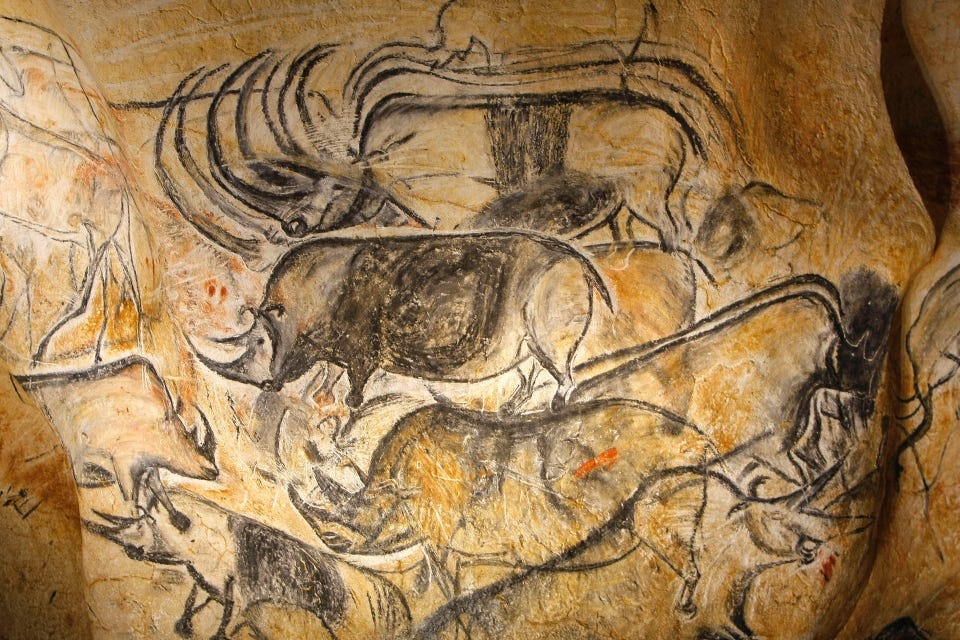
For tens of thousands of years, man has created. He has used the powers of his mind to bring forth that which had not previously existed. He has used his mind and hands to capture aspects of reality and preserve them, creating something new as he does so. You will continue on this tradition.
This step is about using your creative faculties to make something new that at least some other people will appreciate. This could be art, writing, an invention or discovery, or a novel idea that works its way into society. It does not have to be groundbreaking, but it does have to actually affect other people. This cannot be a task you take on merely for yourself. Someone has to be willing to hang your painting, read your blog, live in the room you built, or run with your idea.
This blog is one way that I am creating. Nothing I am doing here hasn’t been said before, but no one has put together these words and ideas as I am right now. And if no one reads this blog, I fail. I will have to keep creating. I don’t need to be change the world with my words, but I do need to change some lives.
Step 4: Give Back
You are the product of millions of years of evolution followed by over 10,000 years of cultural and technological development. Most of this history was brutal. Willing or not, billions have lived their lives in pain and drudgery, and a small handful have had the freedom to develop the thought, technology, and vision that make up our world today. You must honor all of them by giving back to society.
Although society here is abstracted as an entity to give back to, this is really an exercise in paying it forward. If you have already completed the other three steps, you’ve done some amount of paying it forward already. You have developed a habit of generosity, carried weight for others, and created something that others value. Step 4 might overlap with those, but its requirements are more specific. Giving back depends on using your time and resources to help those with whom you are not personally close and with no expectation of compensation. Do this through both charitable giving of money and by volunteering your time.
Give 10% of your income and 4 hours of work per week. These values are fairly arbitrary — if you have developed generosity you may find yourself with the opportunity to give more. But 10% is an achievable goal that society has acknowledged for thousands of years. 4 hours is based on 10% of a 40-hour work week. Again, fairly arbitrary but a laudable goal.
Where should you give? I’m influenced by the effective altruist community, so my inclination is to encourage high impact programs such as malaria prevention. But the lesson to take from effective altruists is not necessarily that you need to donate to popular EA cause areas, but rather that you should think carefully about where your charity money goes. Don’t just go with what is most trendy, which one has the coolest community 5k events, or which one merely boasts “$2 will save 50 lives!” Think about what you would like to support in society and spend at least a little bit of time trying to find out who is doing that effectively.
Where should you volunteer? Try to find something that connects you to your community and whose effects you can see. This does not mean you can’t volunteer for, say, an international aid organization that focuses on people far away. You just need to make sure you can see your impact on the organization and those you are helping. The fact is, your volunteer time is very likely not going to make nearly as big a difference as simply donating, but that’s not what we’re trying to maximize here. Society recognizes men who do. Men who act. This is your opportunity to use your strengths and talents in a way that helps others and honors the project of civilization.
What Next?
I intend to flesh out this system here. As much of a difference I hope this essay makes on men who feel totally lost, there’s a lot of more to do if this is to actually be a roadmap. In addition to detailing how one trains in the various virtues and completes these four steps to manhood, I intend to build a community here of those who wish to grow in their manhood or contribute the discussion of masculinity. Feel free to reach out if you would like to be part of a project that is in need of a new approach.
My biggest issue with this discourse is the lies that the left peddles. And how it seems to be created in self serving and narcissistic way primarily for women to discuss their grievances.
Like "Men are miserable, and their pain is reflected in the rising rate of suicide, depression, anxiety, joblessness, and crime." Crime is down, joblessness among young men is very stable the over past decades in USA and suicide rates are stable too. Why say this? Well, then you can just blame your issues on men not being good enough nowadays, a female version of red pill talking points, instead of acknowledging that you are not good enough to date the men you desire. And this seems like the entire purpose of the majority of the discourse.
Another thing you see is "boys falling behind in education" lie (at least for USA). For PHDs it is true. But for Bachelor's and Master's degrees the gender ratio was flat from 2000-2020 but fell by 2 points after Covid as more boys dropped out to support their families. When it comes to highschool it is just false and measures from SAT, GPA, Graduation rates and Independent Assessments( PISA like tests) are either flat or improved in favour of boys because boys were never ahead in high school.
If you actually look at education and in income (hourly median) you will see that things rapidly reversed in late 20th century but the stabilized between men and women and have been stable for the past quarter of a century.
I love the virtues. I feel like I’m doing ok with most of them, but going through them and reflecting was valuable. Temperance, courage and perseverance are my main areas for improvement.
I like the idea of Carrying Weight, but finance being front and centre strikes me as odd. By saying that it’s not the only way to carry weight implies (to me, maybe this wasn’t intended) that it’s perceived as the main way.
Maybe state who you intend this to be for. For all men? It’ll be incredibly difficult to do that when you’ve only had a narrow slice of all possible experiences. For example, there are many people who don’t have a desire to create for others. Is it truly necessary to create for others, in order to be a man? It feels like a large and growing part of who I am, but I can imagine that not to be true for others. I find it easy to get along with but difficult to relate to the kids at school (I’m a teacher too!) who have the roughest backgrounds. We get on because I respect them as people and I’m clearly on their team, but there’s such an obvious gap in our experiences. I dunno, I guess maybe ponder as you write that for some people, there will always be factors preventing them from getting to the start point (of carrying weight for example), let alone walking the path.
I freaking loved reading Step 4: Give Back! I feel a strong sense of “I don’t deserve what I have because so much is dependent on those who have come before me”, and you’ve articulated it well. I feel like the AND could be an OR. Maybe that’s just me feeling like I don’t have 4 hours in my week. Maybe I really should carve out time for volunteering, or at least strongly intend on doing it in a few years when I do have time.
Good luck!